Direct cremation is often described as the simplest and most affordable funeral option.
That’s usually true—but only if you understand what’s included and what isn’t.
Most confusion (and frustration) around direct cremation comes from one thing:
people assume the quoted price covers everything.
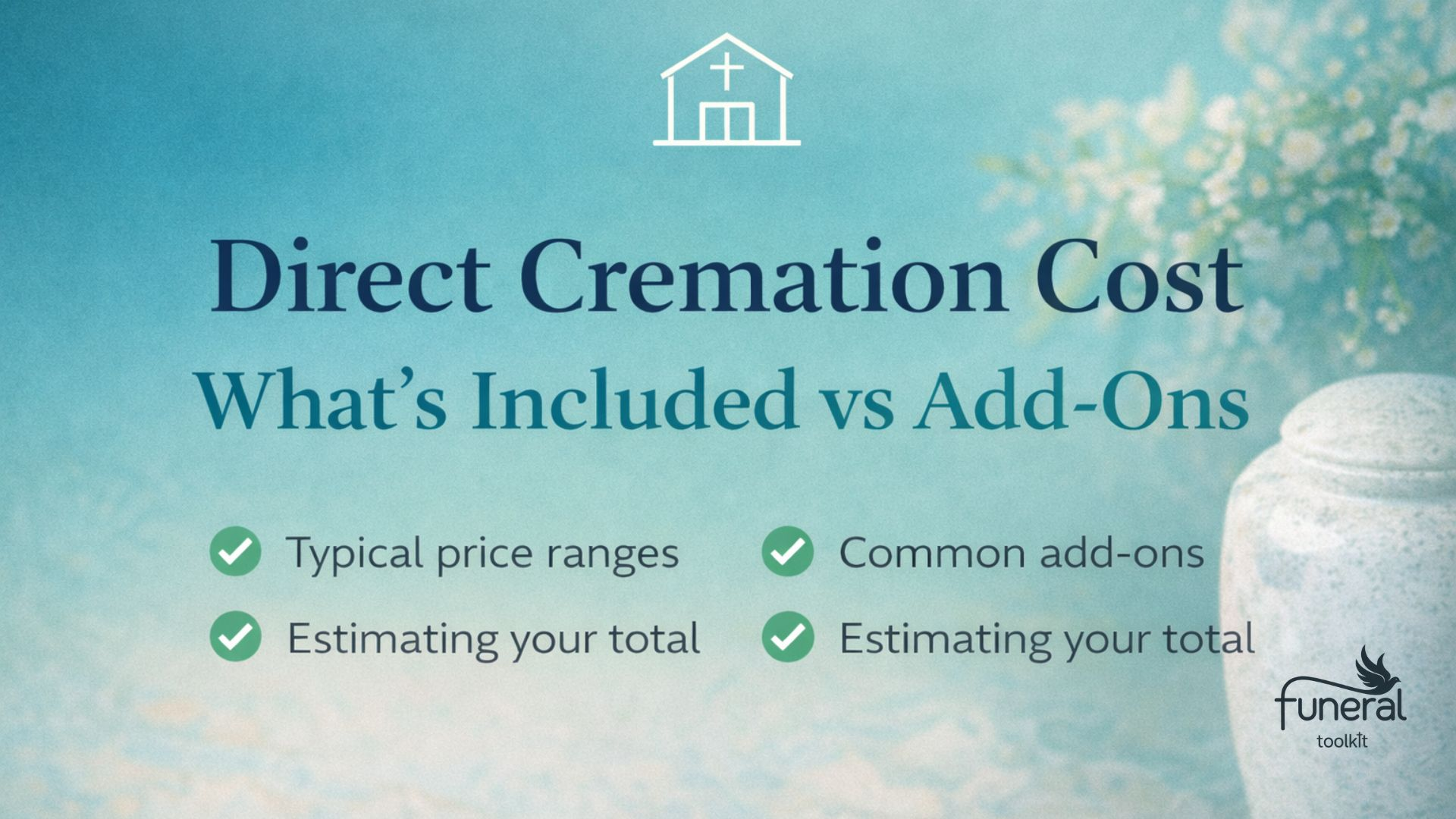
This article breaks direct cremation down clearly—what’s typically included, what often costs extra, and how to estimate your real total before you commit.
What “direct cremation” actually means
Direct cremation means the body is cremated shortly after death without:
- A public viewing
- A formal ceremony at the funeral home
- Embalming (in most cases)
The cremation happens first. Any memorial or gathering happens later—or not at all.
That simplicity is what keeps the base cost lower than other options.
Typical direct cremation cost range
In most areas, direct cremation typically falls between $800 and $3,000.
That range exists because:
- Funeral home overhead varies by region
- Transportation distances differ
- Local regulations affect paperwork and timing
- Some providers bundle more services than others
A low price isn’t automatically better—and a higher price isn’t automatically unnecessary. What matters is what’s included.
What’s usually included in direct cremation
While packages vary, most direct cremation arrangements include the following core items:
1) Basic services fee
This covers the funeral director and staff handling coordination, required paperwork, and oversight of the cremation process.
2) Transportation of the deceased
Typically includes transfer from the place of death (hospital, hospice, residence) and transport to the crematory.
3) The cremation itself
Includes the cremation process and standard handling procedures.
4) A basic container
For cremation, a simple container is required. This is not the same as a casket and is usually included.
5) Filing of permits and authorizations
Most providers handle the required authorizations and permits and coordinate with the crematory.
What’s not usually included (common add-ons)
These items are often optional—but frequently added.
Additional death certificates
Extra certified copies are commonly needed for insurance, banking, and legal matters.
Urns
A basic container may be included, but decorative urns and keepsakes are usually extra.
Obituary publication
Publishing (especially in newspapers) is usually a separate cost, even if you write the obituary yourself.
Witnessed cremation
If family wants to be present, this often adds scheduling and staffing costs.
Holding or refrigeration beyond standard timing
Delays can sometimes add extra holding fees.
Memorial services
Direct cremation does not include a ceremony. A service later (church, venue, reception, printing) is a separate category.
Real-world examples
Example 1: Very simple direct cremation
- Direct cremation package
- Minimal extras
Result: Often near the low end of the range.
Example 2: Direct cremation + memorial later
- Direct cremation
- Extra certificates
- Memorial at a church + printed programs
Result: Still lower than traditional burial, but higher than the base quote.
Example 3: Direct cremation with add-ons
- Witnessed cremation
- Premium urn
- Obituary publication
- Multiple certificates
Result: Can reach the upper end of the range—or beyond.
When direct cremation makes sense
Direct cremation is often a good fit when:
- The family values simplicity
- Loved ones live far away
- A memorial will happen later
- Budget is a major concern
It also gives families time to breathe before planning a gathering.
When it may not be the best fit
Direct cremation may feel limiting if:
- Family members expect a viewing
- Cultural or religious traditions require ceremony
- Immediate community support is important
There’s no “right” choice—only what fits your situation and values.
Use the Funeral Cost Calculator to estimate your total
Instead of asking, “What’s the cheapest option?” ask:
“What will our total likely be with the choices we’re considering?”
That’s exactly what the FuneralToolkit calculator is for.
? Funeral Cost Calculator: https://funeraltoolkit.com/funeral-cost-calculator/
Use it to:
- Compare direct cremation vs. cremation with service vs. burial
- See how add-ons (urns, certificates, services) change your total
- Build a realistic range before you call providers
When you walk in with a clear estimate, you’re less likely to feel pressured or surprised.
A final word
Direct cremation is affordable because it’s simple—not because it’s careless.
When you understand what’s included and what’s optional, you stay in control of both the process and the cost.
Clarity first. Decisions second.