
One of the first numbers many families notice on a funeral estimate is the basic services fee.
It often appears near the top of the price list. It may be described in broad terms. And because the wording can feel general, it is one of the charges people understand least.
That uncertainty matters. When families do not know what a fee covers, they cannot evaluate the estimate clearly.
The basic services fee is usually not a small add-on. It is one of the central charges on a funeral home’s price list. Understanding it brings structure to the rest of the conversation. That is especially true when families are already trying to make sense of broader funeral costs or use a funeral cost calculator to estimate what may be ahead.
Why This Fee Appears on Almost Every Estimate
Most funeral homes include a non-declinable basic services fee in their General Price List. In practical terms, this is the charge that covers the funeral home’s core professional and administrative work, regardless of whether a family chooses burial, cremation, or a simpler arrangement.
That is why it appears so often. It is not tied to flowers, caskets, obituary notices, or cemetery charges. It is tied to the funeral home’s role in managing the arrangement itself.
Families sometimes assume this fee is vague because it is unnecessary. In reality, it is broad because it covers the behind-the-scenes work that makes the rest of the arrangement possible.
What the Basic Services Fee Usually Covers
Although descriptions vary from one provider to another, the fee often includes several common functions.
It may cover the funeral director’s time and professional guidance. It may include planning conferences, administrative work, securing permits, filing paperwork, coordinating with cemeteries or crematories, and maintaining records connected to the arrangement.
It also often reflects overhead that supports every service, whether large or small. That can include staffing availability, scheduling coordination, facility administration, and the systems needed to manage a death from first call through final documentation.
In other words, this fee usually pays for professional oversight, administrative handling, and the infrastructure that supports the funeral home’s services.
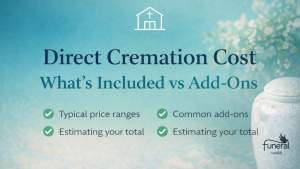
It is not the same as the cost of a visitation, a hearse, embalming, or cremation. Those are often listed separately. If you are comparing simpler arrangements, your direct cremation cost guide can help clarify what is typically priced apart from this base fee.
Why Families Find It Confusing
The confusion comes from the gap between what families see and what funeral homes are charging for.
Families see a single line item. Funeral homes see the professional work that surrounds every case.
Because the fee is often grouped under a broad label, it can feel abstract. A family may look at the estimate and ask, “What exactly are we getting for this?” That is a fair question.
The challenge is that many of the services included in this fee are not visible in the same way a casket or chapel rental is visible. Coordination, administration, and professional supervision are real services, but they are less tangible.
This is one reason funeral estimates feel harder to read than many other kinds of invoices. If the whole process feels murky, it may help to read Why Funeral Costs Feel So Confusing, which explains why these estimates often feel harder to interpret in the first place.
What This Fee Usually Does Not Include
The basic services fee generally does not cover everything.
In many cases, separate charges still apply for transportation of the body, embalming, dressing and preparation, use of facilities for a viewing or ceremony, cremation fees, burial vaults, caskets, urns, hearses, stationery, obituary publication, clergy honorariums, and cemetery costs.
This distinction matters because families sometimes assume a “basic services” line means much more is already included than actually is.
The better approach is to treat the fee as the base professional charge, then read the rest of the estimate line by line. For a broader look at how these charges stack together, see Funeral Cost Breakdown: Every Fee Explained Simply.
A Simple Way to Think About It
A useful way to understand the basic services fee is to compare it to a professional base charge.
It is the cost of opening the file, managing the case, coordinating the moving parts, and making the arrangement possible. It is the fee attached to the funeral home’s involvement before specific services are added.
Once that framework is clear, the rest of the estimate becomes easier to understand.
You are not looking at one large mystery charge. You are looking at the provider’s foundational fee, followed by additional services selected for that particular arrangement.
What Families Should Ask Before Agreeing to It
The right response is not suspicion. It is precision.
Families should ask:
What is included in your basic services fee
Which services are listed separately
Is this fee charged for every arrangement
How does it differ for direct cremation versus a traditional funeral
Are there additional administrative or coordination fees beyond this line item
These questions do not create conflict. They create clarity.
A reputable provider should be able to explain the charge calmly and specifically. This is also where your article on Questions to Ask a Funeral Director Before You Sign becomes especially useful, because it helps families slow down and ask for details before agreeing to the estimate.
Why This Fee Matters in Cost Comparisons
When families compare funeral homes, the basic services fee is one of the most useful lines to review.
That does not mean the lowest number is always the best choice. A lower fee may come with higher charges elsewhere. A higher fee may include stronger coordination or fewer separate administrative charges.
But this line does help families understand how one provider structures its pricing compared with another.
Price comparison only works when similar charges are being compared honestly. If the larger question is how families will manage the total bill, your Paying For a Funeral page is the right next step.
Where This Fits in the Bigger Picture
The basic services fee is not the whole funeral bill. But it is one of the clearest starting points for understanding how the bill is built.
Once families understand this charge, they are better able to evaluate:
- which services are essential
- which are optional
- how providers structure estimates
- what is driving the final total
That kind of clarity reduces pressure. It also makes later conversations about payment, reimbursement, and service selection more manageable. Families already navigating urgent decisions may also benefit from The First 48 Hours After a Death and What Funeral Decisions Must Be Made Immediately — and What Can Wait Safely.
A Practical Way to Review the Estimate
Before signing anything, families should review the estimate in layers.
First, identify the basic services fee.
Second, separate the additional service charges, such as transportation, preparation, facilities, and vehicles.
Third, identify third-party or cash advance items, such as cemetery charges, permits, obituary notices, or clergy honorariums.
This layered approach helps families move from a confusing total to a readable structure.
When the structure is clear, better decisions follow. And if you want a step-by-step planning framework in hand while sorting through these details, your Funeral Planning Checklist and Complete Funeral Planning Guide fit naturally here.
The Bottom Line
The funeral home basic services fee is usually the foundational charge for professional guidance, administrative handling, and case coordination.
It appears on many estimates because it supports nearly every arrangement, regardless of the specific service choices a family makes.
What makes it frustrating is not that it exists. What makes it frustrating is when it is not clearly explained.
Families do not need less information in these moments. They need better information.
And when a single line item starts to make sense, the entire estimate becomes easier to read.