After someone dies, families quickly discover that grief comes with paperwork. Banks may need proof of death. Life insurance companies may ask for a certified copy. Probate, retirement accounts, vehicle titles, real estate, pensions, government benefits, and creditors may all have their own requirements.
That makes one practical question more important than it first appears: how many death certificates should you order?
For most families, a sensible starting point is 6 to 10 certified copies. A very simple situation may only require 3 to 5. A more complicated estate, especially one involving real estate, multiple financial accounts, life insurance policies, retirement plans, business interests, or probate, may require 10 to 15 or more.
That range is not a legal rule. It is a planning guide. The better method is to count the institutions that may require proof of death, then order enough certified copies to handle the first round of paperwork without paying for far more than you need.
What Is a Certified Death Certificate?
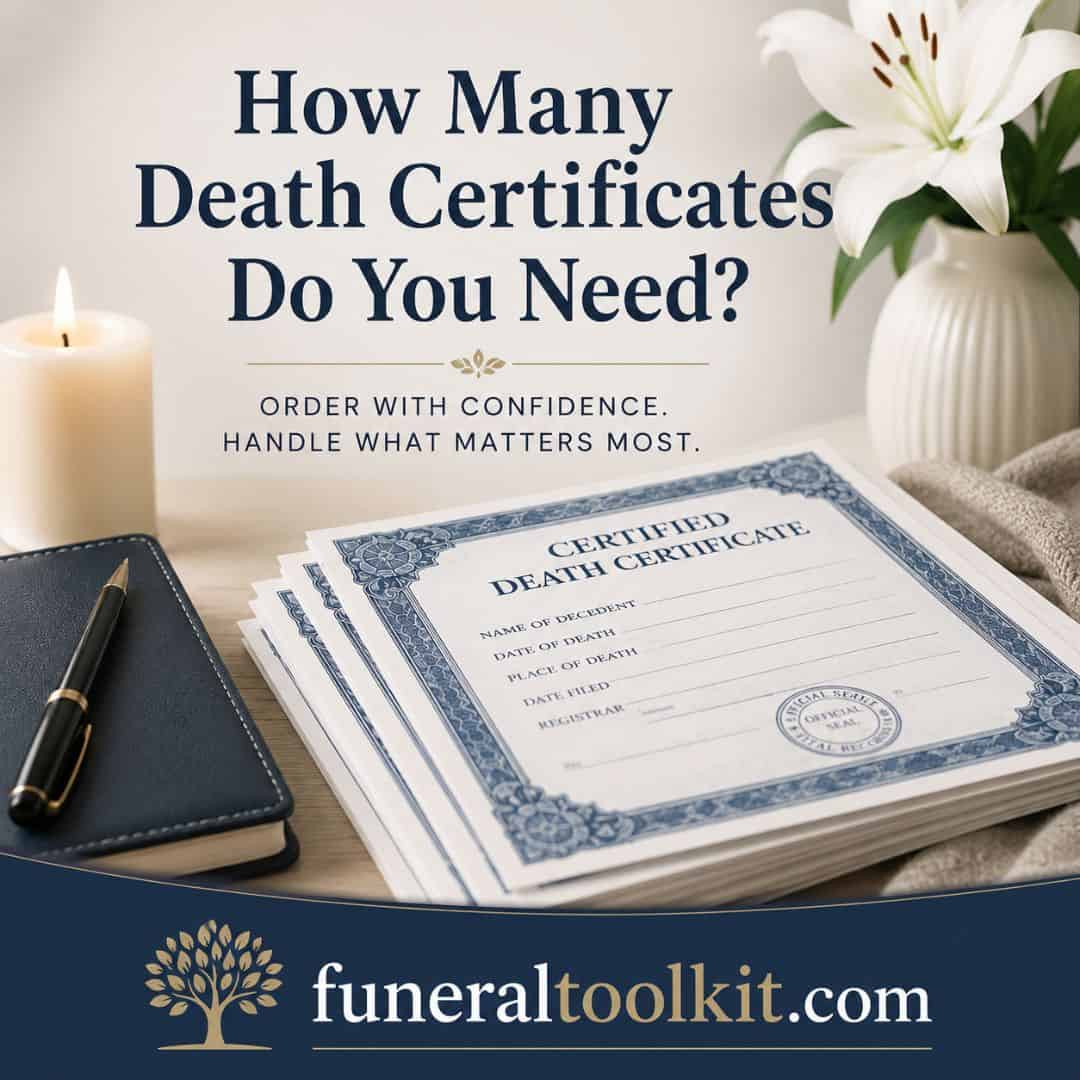
A certified death certificate is an official copy issued by the state, county, city, or local vital records office. It usually carries a seal, stamp, watermark, signature, or other official mark showing that it is a government-issued record.
A regular photocopy is not the same thing. Many organizations will not accept a photocopy when money, property, benefits, legal rights, or account transfers are involved. For lower-risk tasks, a scan or photocopy may be enough. Canceling a subscription, closing a membership, notifying a club, or updating a nonfinancial account often does not require an original certified copy. Families who are still organizing the first day or two of decisions may also want to keep this paperwork alongside The First 48 Hours After a Death.
Still, every company sets its own process. Before mailing an official certificate, ask: “Do you require a certified death certificate, or will a photocopy work?”
A Practical Starting Range
The number of death certificates needed depends less on the funeral itself and more on what must be settled afterward.
A simple situation with few accounts, no real estate, no probate, and no life insurance may only require 3 to 5 certified copies. A typical family estate with bank accounts, insurance, retirement benefits, and basic administrative tasks often falls in the 6 to 10 range. A larger estate with multiple policies, pensions, investment accounts, real estate, vehicles, business interests, or probate may need 10 to 15 or more.
The goal is not to guess high. Certified copies cost money, and some offices add processing or shipping fees. The goal is to make a careful first estimate so the paperwork does not stall while the family waits for more copies. For families also trying to estimate burial, cremation, service, and related expenses, the Funeral Cost Calculator can help put the paperwork costs in the larger planning picture. If payment decisions are already pressing, Paying for a Funeral explains the common options families consider when funeral costs have to be handled quickly.
Who May Need a Certified Copy?
Life insurance companies commonly ask for a certified death certificate before processing a claim. Retirement plans, pensions, annuities, and employer benefit administrators may also require official proof before releasing funds to beneficiaries.
Banks and credit unions may request proof of death before closing, freezing, retitling, or transferring accounts. What happens to an account depends on how it was titled, whether there was a joint owner, and whether payable-on-death or beneficiary designations apply. Probate courts and estate attorneys may need a certified copy if an estate must be opened or administered.
Social Security is another common concern. Funeral homes often report deaths to Social Security, but if that does not happen, the family should contact SSA directly. The family may also need the person’s Social Security number and certified copies of the death certificate for other government agencies or benefit programs.
Vehicle title offices, real estate offices, mortgage companies, investment firms, creditors, and veterans benefit programs may also ask for a certified copy. Some will return the certificate after review. Others will keep it. Ask before sending one, especially if you are down to your last copy.
Short Form vs. Long Form Death Certificates
Some states offer more than one version of a death certificate. The most common distinction is between a short form, which does not include cause-of-death information, and a long form, which does.
This is not handled the same way everywhere. Some states use short forms for general estate or title matters and long forms for insurance, banking, or benefit claims. Other states have their own terminology and access rules. In some places, cause-of-death information may be restricted for a period of time or available only to certain eligible people.
The practical point is simple: before ordering, ask whether you need copies with cause of death, without cause of death, or a mix of both. For many estate tasks, the version without cause of death may be enough. For life insurance, insured loans, certain benefits, or medical-related claims, a long form may be required.
Where Do You Order Death Certificates?
In the United States, death certificates are generally ordered from the vital records office in the state or local jurisdiction where the death occurred, not necessarily where the person lived.
In many cases, the funeral home can help order the first set of certified copies. That can save time because the funeral home may already be gathering the information needed for the death record. If the death happened at home and the family is still working through the immediate next steps, use What to Do Immediately After Someone Dies at Home alongside this guide.
Families should still ask what is included, what is charged separately, and whether the funeral home adds a service fee.
Before ordering through the funeral home, ask three questions:
- How much does each certified copy cost?
- Is there an additional service fee?
- Can I order more later directly from the vital records office?
Ordering through the funeral home may be easier for the first round. Ordering directly from vital records later may be cheaper or necessary if additional copies are needed.
How to Estimate the Right Number
Start with one certified copy for each major institution or transaction that may require one. Count life insurance companies, retirement administrators, banks, investment accounts, probate court or estate counsel, vehicle title offices, real estate or mortgage matters, and government benefit claims. Add one or two extra copies for unexpected requests.
For example, if a person dies leaving one bank account, one life insurance policy, one vehicle, a small IRA, and no real estate, the family may be fine with 6 or 7 certified copies. One may go to the insurance company, one to the IRA administrator, one to the bank, one to the title office, one to the attorney or probate process if needed, and one or two can be kept in reserve.
A larger estate is different. If the person had two life insurance policies, a pension, a 401(k), three bank accounts, a home, a vehicle, a brokerage account, a mortgage, and a probate estate, 10 to 15 certified copies may be more realistic.
When Is a Photocopy Enough?
A photocopy or scan may be enough for lower-risk notifications. That can include subscriptions, memberships, utilities, social media accounts, church or club records, and simple account updates where no money or property is being released.
Do not assume, though. A company that accepted a photocopy for one family may require a certified copy from another. Policies vary, and the person answering the phone may not know the full requirement. Ask directly, write down the answer, and keep a simple record of where each certificate was sent.
Common Mistakes to Avoid
The most common mistake is ordering from the wrong jurisdiction. Order from the state or local office where the death occurred.
The second mistake is ordering too few. If a family orders only one or two certified copies, the estate paperwork can stall almost immediately.
The third mistake is ordering too many without counting. A complicated estate may need 15 or more, but a simple situation may not.
The fourth mistake is ordering the wrong version. Some families send cause-of-death information when it is not needed. Others order a short form when an insurance company or financial institution requires a long form.
The fifth mistake is mailing certified copies without tracking them. Keep a log with the date sent, organization, purpose, mailing method, and whether the certificate should be returned.
Bottom Line
Most families should begin with 6 to 10 certified death certificates. Order fewer, around 3 to 5, if the situation is simple and there are few assets or accounts. Order more, often 10 to 15 or higher, if there are multiple insurance policies, retirement accounts, real estate, investments, vehicles, business interests, or probate issues.
Before ordering, make a quick list of the organizations you expect to contact. Ask each one whether it needs a certified copy, whether a photocopy will work, whether cause-of-death information is required, and whether the certificate will be returned. For a broader organizing tool, use The Funeral Planning Checklist Most People Don’t Know They Need Until They Do to keep the certificate count connected to the rest of the family’s decisions.
This is not just paperwork. It is one small way to create order at a time when the family is already carrying enough.
Need a calmer way to organize the first steps after a death? Start with FuneralToolkit’s first-step guides and planning tools, then use The Complete Funeral Planning Guide to document the decisions your family should not have to guess later.